LLP Logo

LLP Logo

Tuesday, 27 December 2011

Merry Christmas 2011! Part 2.

On December 20, 2011, we were invited to the Ethnographic Museum from Baia Mare for the official varnishing of the traditional Christmas trees from the region of Maramures, which took place at the museum.
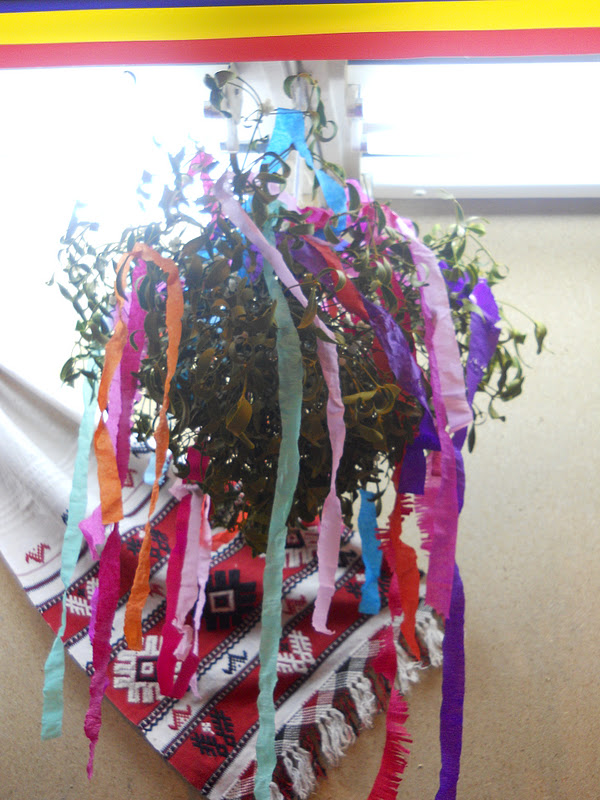
Mrs. Malvina Mada told us that in the old times, before the introduction in Transylvania of the Christmas Fir tree by the Germans who settled here approx. in the 17th century, people in Maramures used to decorate their hoimes and make a Christmas tree from different materials they had in the house (cookies, nuts, other food items, tree branches, mistletoe, etc.), which were considered to bring good health and wealth to the family in the new year.
Here are some examples of such Christmas tees


After our hosts and their guest speakers told us about the history and symbolism of these Christmas trees,  all the students present here, from several kindergartens from Baia Mare, and the students from grades 2B, 3E, 4A and B and their teachers, from Scoala "Vasile Alecsandri from Baia Mare, as well as the students and adults from the choir from the village of Oarta, Maramures, sang some very beautiful traditional Christmas carols. The atmosphere was filled with emotion for all those present.


Merry Christmas 2011!


Preparing for Christmas 2011
This year, for Christmas, the Romanian team has organized several fun activities:
- We prepared decorations  for our ethno Christmas trees


We went caroling to the Ethnographic Museum. It was on December 19, 2011, with grades 5B, 6A and 7B.


Monday, 19 December 2011

Christmas Eve prophecies and witchcraft in Lithuania


• While seated at the table, look at the walls where the candlelight casts the shadows of those dining. If your shadow is large, wide and of the whole person, the year will be good, there will be no illness, everything will go well. If the shadow lacks a head a terrible calamity will occur; if it is skinny, unclear and wavering, the year will be difficult.
• Other predictions may be made while still at table. Three plates are used, a key is placed under one, a ring under the second and a coin under the third. The plates are mixed and one is chosen. The ring signifies love, marriage; the key means owning an apartment or house; while the coin indicates a prosperous year. A piece of paper is crumpled, placed on a plate or cutting board and its shadow examined. The first impression is decisive. If a form of transportation is seen, the person will travel a great deal next year; if a house or building, a move will be made to a new place; if a flower or other plant, a wedding will be held; if a cradle, a new family member will arrive; if a coffin or burning candle, death. Similar prognostications are performed by pouring melted wax into cold water and examining its shadow.
The country people believed that Christmas Eve night was miraculous: various omens and rituals could not only be used to predict the future but all of nature felt the significance of the night. At exactly midnight all animals were able to speak like humans. But to listen to their conversation was extremely dangerous because you could learn the day of your death. At precisely midnight all water turns into wine, you must simply hit the correct moment which is of very short duration. If the sky is clear on Christmas Eve night and full of stars, the year will be good. That night you must also pray before retiring else nightmares will trouble you all year.
• After dinner a girl sweeps the floor, pours the sweepings into her apron, takes them to a crossroads and tosses them out. Then she stands and listens from which side dogs are barking, from there she will get a husband.
• Sitting with her back to the door, a girl throws a shoe over her head: if the shoe lands with the toe toward the door she will leave home that year (marry, go to a distant school; a man will leave for the army, a faraway job, etc.). If the shoe heel faces the door, he or she will remain at home.
• All the shoes in the house are gathered together and placed in a pile, they are then lined up one behind the other to the door. The person whose shoe touches the door will be the first to leave home (some say, the first to die).
• To see the future, go into an empty room after the Christmas Eve supper, prop a mirror against the door, bend down and look at the mirror through your legs: you will see your future husband or wife.
• Take a full glass of water, a gold wedding band, a mirror and two candles. Place all the items on a white tablecloth. The wedding band is dropped into the glass, the candles are lit and placed on either side of the mirror. Sit in front of the mirror, take the ring out of the glass with your fingers and then drop it back in. Do this three times. The third time you remove the ring from the water, look through it into the mirror: you will see your future or the man you will marry.
• Drip several drops of wax from a blessed candle into a cold glass of water. Place the glass by your bed. That night you will dream about your future spouse.
• Take a bowlful of water and twelve pieces of paper written with men's names. Fold the papers over the bowl's rim so that one half hangs over the water. Place a piece of candle into a sliver of potato or turnip, light it and float it on the water. Stir the water with a finger to cause the candle to float around. The paper at which it stops or which it sets on fire indicates your husband's name. Questions about the coming year can also be written on the pieces of paper, but the answer can only be "yes" or "no". The paper which the candle lights or at which it stops means that those things will come true.
• The simplest form of fortunetelling is to count in twos. Dry slizikai, matches, peas, firewood by the hearth, candy or anything else can be counted. If it comes out in pairs, a wedding will take place next year.
Let your Christmas Eve be meaningful and peaceful!

Sunday, 18 December 2011

Boże Narodzenie w dawnej Polsce = Christmas in old-time Poland


* * *

For Poles, Christmas Eve is a time of family gathering and reconciliation. It's also a night of magic: animals are said to talk in a human voice and people have the power to tell the future. The belief was born with our ancestors who claimed that Dec. 24 was a day to mark the beginning of a new era. It was bolstered by sayings such as, "As goes Christmas Eve, goes the year." Hoping for a good 12 months, everyone was polite and generous to one another and forgave past grievances.

From the small hours on Dec. 24, women were found cleaning and sweeping the entire house. An ancient belief had it that forces of evil would dwell in all things left dirty on that day. If the first person to enter a house on Christmas Eve was a woman, it was a bad omen, meaning that only heifers would be born in the farm in the coming year. It was a good sign when a man was the first to cross the threshold of the house.

* * *

At the Christmas Eve supper, each dish had to be sampled, and a traditional meal would consist of 12 dishes. The more you ate, the more pleasure would await you in the future. The more daring diners would pull out blades of straw from underneath the table cloth. A green one foretold marriage; a withered one-waiting; a yellow one-spinsterhood; a very short one-an early grave.

In pre-electricity times, after the last supper dish (which was kutia, a mix of soaked wheat, raisins, nuts, honey and spices) candles were blown out and the direction of the smoke was observed. If it moved toward the window-the harvest would be good, toward the door-a family member would die, toward the stove-a marriage.

after: http://www.polishworld.com/christmas/

* * *

Christmas time is approaching and the Polish teamwants to wish all our partners from all our partner schools, their teachers, students and parents

Merry Christmas and a Happy New Year!

* * *

Also, we would like to present you with the calendar we have prepared thanks to your work and some decorations for the Christmas tree that were sent to Romania for the expo. The calendar can be downloaded from facebook “Ethno Treasure Hunt” group.


Saturday, 10 December 2011

ETHNO TREASURE HUNT STORY

„Ethno Treasure Hunt”

story

written by partner schools

from

Romania

Italy

Turkey

Lithuania

Bulgaria

&

Poland


Chapter 1

Once upon a time there was a lady called Daniela whose king ordered her to gather a fellowship of six kingdoms to search for a treasure which will give joy to mankind.

The king wanted to deposit the treasure in a Treasure Agency so that everyone could use it and broaden their minds. Daniela was thinking for a long time and one day it came to her that the greatest treasure of all will be that of national folklore. Therefore, she set off on a journey which she announced as “Ethno Treasure Hunt”.

Chapter 2

Daniela sent messengers to the 6 kingdoms to gather the fellowship. And they gathered first in Romania to plan for the hunting sessions. They also hunted for the Romanian treasures: tzuika (palinca), Dracula’s castle, old houses, small straw hats and happy dancing.

The next hunting session was in sunny Sicily. They visited Lady Etna for a cup of tea, the Godfather in Savoca and Salvatore Quasimodo in Roccalumera. They chased the old Greeks in Agrigento and fished for dinner in Santa Teresa di Riva.

Later on, the hunters got on their horses and they flew to Turkey. They met the dark knight who invited them to tea parties in Denizli. They swam in the cotton castle at Pamukkale and hunted the world’s wonders in Efes. They stopped for lunch in Babadag and hunted for dolls in Sirince and for the Pigeon Island in Kusadasi. They gathered around the intercultural table and tasted the foods and spirits. They also planned more hunting in Lithuania, Bulgaria and Poland.

“So... treasure hunters from all countries, unite!”- exclaimed lady Daniela trying to gather her dear companions. “It’s time for us to rest for a while before another trip, “ she said. And so, the fellowship of treasure hunters went to a nice peaceful sleep to gain energy before another amazing long hunt.

Chapter 3

In autumn, Lady Daniela called all her treasure hunters again to fly to an unknown new land in the north and so they landed in the country of Duke Vytautas: LITHUANIA.

The Polish team came first. The vehicle they arrived was Zeppelin. It landed in Panevezys. Together with their Lithuanian mates they started preparations for welcoming other teams and looked forward to the meeting. The next day, two female knights from Lithuania took on their carriage fearless Polish friend knights. They treated the Polish friends with tasty cheese (dżugas) and delicious honey and apples. After a short meal, they all went to a nearby country, Latvia, to collect their dear companions from Riga. First, they met with the Turkish ladies accompanied by their guide and leader, the dark night of Turkey. The greeting was warm and feelings rose up high. Together they set off to meet other companions from Bulgaria. Ethno hunters were very happy to finally meet together. In high spirits they visited a part of Riga and when it started getting darker they all set for Panevezys. As soon as they arrived at Panevezys and settled down in a beautiful place called Sermutas, they met their beloved leader Lady Daniela. Hugs and kisses flowed from their hearts and smiles and laughters were heard till late at night. However, they were not fully happy: they were waiting for other friends to come: the Italian warriors from a faraway Sicily. The next day, they were about to meet them at school.

So all the treasure hunters gathered at Velzys Gymnasium the other day and sang with children. Then, they met Mama Ona, who taught them about her family traditions and had them try all the house chores using the “hands-on” method. After she fed them in a traditional way, she took them to a dancing party. They also learnt to bake the traditional Lithuanian bread and they cooked an international dinner together.

One day, when they went on hunting, they came across a stranded Lithuanian farm. There, they found many horses faster than a thunder and brighter than a star. Riding through dark forests and green fields of time, they arrived at the 19th century. They cut their own wood, built their own house and baked their own bread in silence, peace and respect. They were all in their white shirts and colourful aprons. They sang songs that they learned from trees of windy forests. When they were leaving, they took a roof which, from now on, they would always carry over their heads to protect them from devil eyes. They saddled their horses and off they went! After a long journey and tiring, the horses brought them back to present times. Now, they could rest in their stable till the next hunting event. The news has it that the next hunting experience was to take place in Bulgaria. So on the last Lithuanian night, they all fell asleep with their heads full of hopes, happiness and love, dreaming about the next opportunity to be together and experience the impenetrable, explore the unknown and hunt the ephemeral again and again more and more…


Tuesday, 6 December 2011


It is a tradition in Baia Mare that on December 5, just before St. Nicholas Day, here in Romania, our Mayor rewards the students who won prizes in international and national competitions during the last school year and their coordinating teachers, too.
Dan Cont and I were honoured to be awarded a prize and a Diploma of honour for the very good results we got in the National competition "Made for Europe", the 5th edition, organized by the Romanian Ministry of Education.

Dan represented our school and project in the contest. At the regional level he got 1st prize and at national level he got 4th prize, which is a remarcable achievement, as there were hundreds of project presented in the national competition. It is another recognition of the high quality of our project.
The National contest "Made for Europe" is a competition organized byt MECTS for the valorization and promotion of the best practices and experiences in education andresearch, resulted from projects financed by the European Commission from European community funds.
Romanian version:


Ca in fiecare an, Primaria Baia Mare a organizat premierea elevilor cu rezultate deosebite la concursurile nationale si internationale, si a profesorilor care i-au pregatit.
In anul 2011, la cea de a V-a editie a concursului, elevul Dan Cont, de la Scoala cu cls. I-VIII “Vasile Alecsandri” Baia Mare, coordonat de prof. Daniela Buda, ne-a reprezentat la Concursul National “Made for Europe”. La faza judeteana el a obtinut Premiul I, iar la faza nationala Mentiune pentru prezentarea si promovarea proiectului nostru.
Datorita rezultatelor deosebite obtinute, atat el cat si profesoara care l-a pregatit, au fost premiati de catre Pimaria Municipiului Baia Mare cu Diploma de onoare.
Concursul National “Made for Europe”, organizat de Ministerul Educatiei Cercetarii Tineretului si Sportului, are ca obiectiv “valorizarea si promovarea experientelor positive acumulate de unitatile din invatamantul preuniversitar in derularea proiectelor finantate prin programele comunitare din domeniul educatiei si formarii profesionale” (www.edu.ro)
Proiectul Multilateral Comenius “Ethno treasure hunt” (“Vanatoarea de comori etno”), http://ethnotreasurehunt.blogspot.com , coordonat de Scoala cu cls. I-VIII “Vasile Alecsandri” Baia Mare, are ca parteneri scoli din Polonia, Lithuania, Turcia, Italia si Bulgaria https://sites.google.com/site/ethnotreasurehunt/.
Cateva din obiectivele proiectului nostru sunt: cercetarea traditiilor si obiceiurilor din cele sase tari; promovarea si valorizarea creativitatii elevilor si cadrelor didactice implicate in proiect; dezvoltarea competentelor lingvistice (limba maternal si limbi straine) ale participantilor; dezvoltarea competentelor lor digitale, etc.
In perioada 2010-2012, echipa scolii, impreuna cu echipele din celelalte 5 tari, desfasoara activitati de cercetare folclorica si ethnografica din zonele in care locuiesc, activitati creative si de diseminare si promovare a proiectului si produselor finale.
Din Scoala “Vasile Alecsandri” sunt implicati un numar de 30 cadre didcatice si peste 200 elevi de diferite varste.
Cateva din produsele finale ale proiectului sunt: “Ethno treasure hunt – Costume traditionale din Europa, Carte de colorat” si joc de carti; website-ul si blogul proiectului, e-grupul de discutii al profesorilor; Cursul optional de origami; expozitii de arta cu creatiile elevilor (realizate de catre echipa romana), grupul cu acelasi nume de pe Facebook; Calendarul cu sarbatori; cartea cu descrierea traditiilor si obiceiurilor “Ethno treasure hunt – European traditions and customs”, un DVD cu cantece traditionale; imnul proiectului, etc.
Va invitam sa vizitati blogul si website-ul proiectului pentru a afla mai multe informatii.
Daniela Buda, coordonator European al proiectului.

Friday, 2 December 2011

Dissemination activity at the regional teachers' meeting, Decemeber 2011, Romania


On December 2, 2011, the teachers from the county of Maramures had their 1st semester meeting. Each year we meet once a semester to exchange examples of best practice and information on methodology topics.
This semester, the teachers of English from the region of Baia Mare, one of the groups, which I am part of, met in Tautii Magheraus, a small town near Baia Mare. The hosts waited for us and provided very good conditions for our meeting to go well.
In the meeting plan, there were some materials sent to us by the Maramures School Inspectorate, an example of best practice in the work with students with special educational needs and in the attempt to recuperate students with school failure and a workshop on using different crosswords puzzles in teaching. Last, but not least, I proposed to disseminate an example of best practice within our project: another way of teaching English to students with special educational needs - using origami in teaching.


My topic came to complete the materials presented by my colleagues.
My colleagues from other schoola were very interested in my presentation of the project: I presented the project website and blog, the Coloring book with traditional costumes and the materials made by students and which I use in teaching them English.
I think the presentation was very successful, considering the fact that I had very good feedback from the teachers present there.
I have also been invited to an international conference on European culture held on December 16 at the History Museum in Baia Mare. I promissed to go there and introduce our project and its intercultural end products made by our extraordinary international team.
I will keep you informed about that event, too.
Daniela Buda